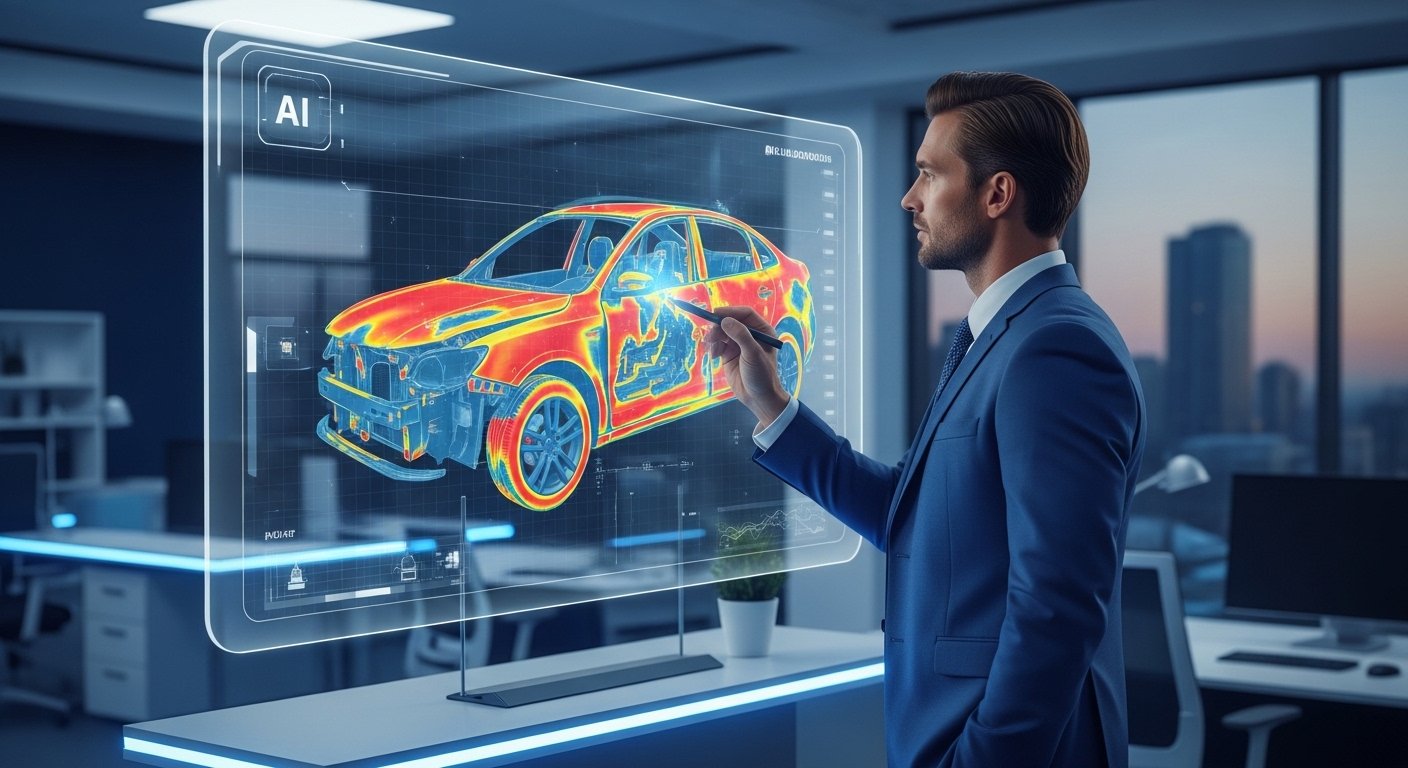
The insurance industry is undergoing a massive digital transformation. Traditionally, insurance adjusters had to spend days traveling to sites, manually inspecting damages, and calculating costs. However, in 2026, AI for automated damage assessment has revolutionized this workflow, allowing professionals to assess losses with unprecedented speed and accuracy using nothing more than smartphone photos.
For modern insurance adjusters, AI is not a replacement but a powerful co-pilot. By automating the “grunt work” of identification and measurement, adjusters can focus on high-level decision-making and customer empathy.
Understanding Computer Vision in Insurance
The core technology behind this shift is Computer Vision. This branch of AI enables machines to “see” and interpret visual data just like a human eye, but with the added benefit of massive data processing.
When a claimant uploads a photo of a collapsed roof or a dented car fender, the AI analyzes the pixels to:
- Identify the Object: Recognize the specific make, model, or material.
- Detect Anomalies: Compare the current state against a “perfect state” database.
- Measure Extent: Calculate the square footage of damage or the depth of a structural crack.
How Insurance Adjusters Implement AI Workflows
To successfully integrate AI for automated damage assessment into your daily routine, you must follow a structured technical protocol.
1. High-Fidelity Data Acquisition
The quality of the AI output depends entirely on the input. In 2026, adjusters use specialized mobile apps that guide users to capture “AI-ready” photos.
- Proper Lighting: Avoid harsh shadows that might confuse the algorithm.
- Multi-Angle Coverage: Ensure the AI can build a spatial understanding of the damage.
2. Automated Feature Extraction and Analysis
Once photos are uploaded to the cloud, the AI performs “feature extraction.” It automatically catalogs every scratch, dent, or broken seal. This removes the “human error” factor where an adjuster might overlook a small but critical structural weakness.
3. Real-Time Severity Scoring
AI systems now provide a “Severity Index.”
- Category 1 (Minor): Cosmetic issues that can be settled instantly via automated payment.
- Category 4 (Critical): Immediate structural threats that require an on-site professional engineer.
Key Benefits of AI-Driven Claims in 2026
Why is the industry moving so aggressively toward AI for automated damage assessment? The metrics speak for themselves.
Unmatched Efficiency and Speed
The primary advantage is the reduction in “Claim Cycle Time.” Claims that previously took 14 days can now be settled in under 24 hours. This speed is a major competitive advantage for insurance firms looking to improve customer retention.
Precision and Cost Control
AI doesn’t have “off days.” It provides consistent estimates based on real-time market prices for labor and materials. This prevents overpayment and ensures that the claimant receives exactly what is needed for a full recovery.
Advanced Fraud Mitigation
Fraudulent claims cost the industry billions annually. AI algorithms can now detect “photo shopping,” metadata inconsistencies, or damages that were previously claimed on different policies, effectively flagging suspicious activity before a payout is made.
The Step-by-Step AI Adjustment Workflow
For a professional adjuster, the 2026 workflow looks like this:
- Intake: The policyholder submits photos via a mobile portal.
- Triaging: The AI automatically categorizes the claim by type and severity.
- Damage Detection: The engine runs a deep-learning analysis to quantify the loss.
- Verification: The adjuster reviews the AI’s findings, makes necessary tweaks, and approves the final report.
Strategic Integration & Resources
The use of AI is expanding across all sectors of ZumTel’s interests. For instance, you can see how AI agents in real estate are qualifying leads, or how AI workflows for dentists are managing patient reviews. If you are looking to build your own assessment tool, our guide on how to deploy an AI chatbot provides a great technical starting point.
For more information on the underlying technology, refer to the Wikipedia entry on Deep Learning.
Case Study: Post-Disaster Rapid Response
In a recent 2026 flood event, a Tier-1 insurance carrier utilized AI for automated damage assessment to process over 10,000 claims in 72 hours. By using drone-captured imagery processed through computer vision, they were able to issue emergency funds to families within hours, a feat that would have been impossible with traditional manual adjusting.
The Future: From Assistance to Autonomy
We are moving toward a future of “Touchless Claims.” While complex cases will always require human expertise, the vast majority of high-frequency, low-severity claims will soon be handled entirely by AI agents. As an adjuster, mastering these tools today ensures your relevance in the high-tech landscape of tomorrow.
People Also Asked (FAQs)
Q1: Will AI replace human insurance adjusters? No. While AI handles data processing and initial assessment, the human adjuster is essential for complex negotiations, legal compliance, and providing emotional support to policyholders during stressful times.
Q2: How accurate is AI in estimating repair costs? By 2026, AI models are integrated with global parts and labor databases, providing accuracy rates of over 95% for standard vehicle and property repairs.
Q3: Can AI detect if a photo has been tampered with? Yes. Modern AI tools use forensic analysis to check for pixel manipulation, metadata changes, and “deepfake” imagery to prevent insurance fraud.
Q4: Is this technology expensive for small agencies? While the initial setup involves a subscription, the “per-claim” cost is significantly lower than the labor cost of a manual inspection, making it highly cost-effective for agencies of all sizes.
Q5: Does Meta AI or Gemini work for this? Yes, specialized versions of models like Gemini and Llama (Meta AI) are often used as the “brains” for these assessment platforms due to their high reasoning capabilities.
Conclusion
AI for automated damage assessment is the definitive tool for the modern insurance adjuster. It bridges the gap between massive data and actionable insights. By adopting these 2026 SEO-optimized strategies, insurance professionals can ensure they remain at the forefront of the industry while providing the best possible service to their clients.